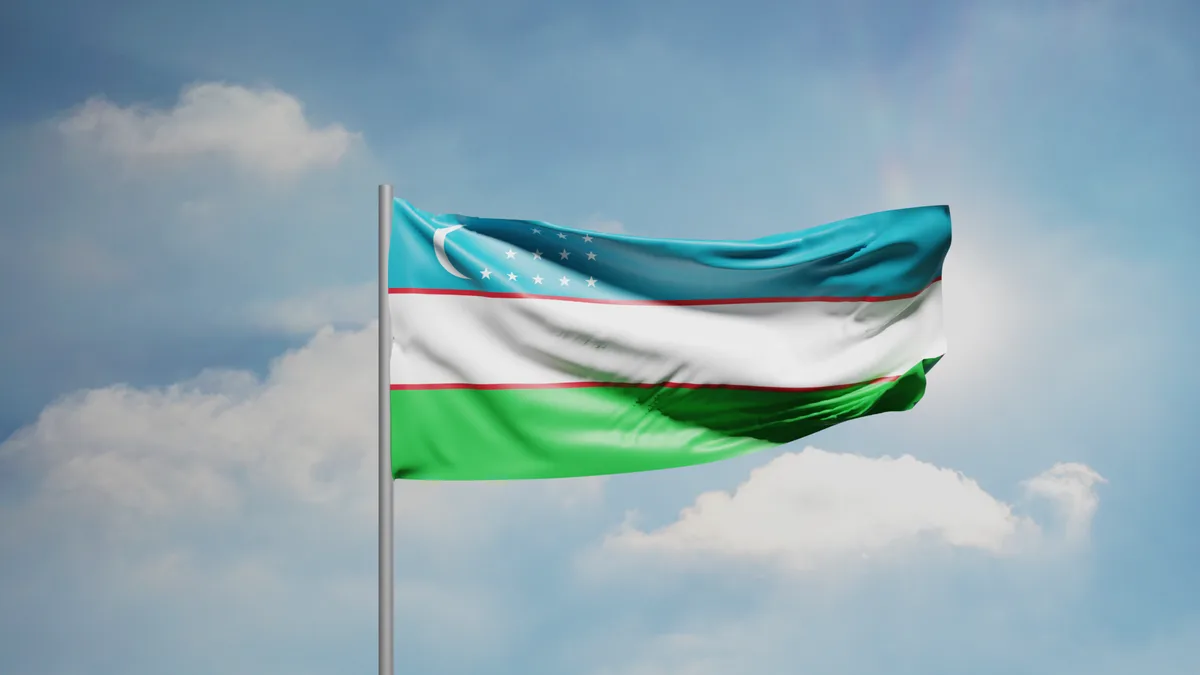
Uzbekistan
| Country of origin | Uzbekistan |
|---|---|
| First created | 1992 |
| Original use | Professional football competition |
| League | Uzbekistan Super League |
| Top domestic competition | Uzbekistan Super Cup |
| Top continental competition | AFC Champions League |
| Primary stadium | Milliy Stadium, Tashkent |
Origin and history
Uzbekistan is a sovereign nation located in Central Asia. Its modern borders and national identity were formed in the 1920s during the national delimitation of the Soviet Union. The territory was incorporated as the Uzbek Soviet Socialist Republic, a constituent republic of the USSR. The region itself has a far deeper history, having been part of ancient empires like those of the Persians and Mongols, and a core area of the Silk Road with historic cities such as Samarkand and Bukhara. Uzbekistan declared its independence from the Soviet Union in August 1991, becoming a fully recognized independent state. The modern nation-state's formal structures and international sporting affiliations were established in the early 1990s following independence.
What it is for
As a member nation of the Asian Football Confederation (AFC), Uzbekistan exists within this context as a footballing entity comprising national teams, a domestic league system, and football clubs that participate in continental competitions. Its primary footballing purpose is to organize, govern, and develop the sport within its sovereign territory. This involves fielding national teams for AFC-sanctioned competitions such as the AFC Asian Cup and FIFA World Cup qualifiers. Domestically, it maintains the Uzbekistan Super League and associated cup competitions to foster local talent. The structure also serves to qualify its top clubs for AFC tournaments like the AFC Champions League and AFC Cup. Furthermore, its football federation implements youth development programs and coaching education aligned with AFC guidelines.
Overview
The Uzbekistan Football Association is the governing body for football in Uzbekistan and is a full member of both the AFC and FIFA. The men's national team, known as the White Wolves, has been a consistent performer in Asian football since the 1990s. The domestic top flight is the Uzbekistan Super League, which has been dominated historically by clubs such as Pakhtakor Tashkent and Bunyodkor. Uzbek clubs regularly compete in the elite AFC Champions League, with Pakhtakor Tashkent having reached the semifinals in the early 2000s. The women's national team and youth national teams also participate in their respective AFC competitions. The country has invested in football infrastructure, including stadiums meeting AFC standards in Tashkent and other major cities.
What to know
Uzbekistan has never qualified for the FIFA World Cup finals but has come close on several occasions, often reaching the final round of AFC qualification. The nation won the AFC U-16 Championship in 2012 and the AFC U-23 Asian Cup in 2018, highlighting a strong focus on youth development. Its domestic league season typically runs from March to November, aligning with many other Central Asian nations but contrasting with the East Asian calendar. Uzbekistan has occasionally hosted AFC competitions, such as the 2010 AFC Women's Asian Cup and group stages for various youth tournaments. Naturalized players, particularly of Korean descent, have featured in the national team setup in the past. The style of play associated with Uzbek teams often emphasizes technical skill and physical robustness.
Common questions
A common question is why Uzbekistan, despite its talent pool, has failed to qualify for a World Cup, often attributed to inconsistencies in key matches and managerial instability. People often ask about the most successful club, which is Pakhtakor Tashkent with numerous league titles and the best continental record. Many inquire about the national team's nickname, the White Wolves, which symbolizes pride and ferocity in local culture. Questions arise about the league's competitiveness relative to neighbors, generally considered stronger than Tajikistan or Kyrgyzstan but behind the top-tier West Asian leagues. People frequently ask if Uzbek players require visas for other AFC nations, which depends on bilateral agreements and tournament hosting rules. Another common query is about the development path for young players, which flows through specialized football academies and the junior national teams.
Pros and cons
A significant pro is a well-established and historically strong youth development system that consistently produces talented players competitive at the Asian age-group level. The domestic league is stable and professional, providing a solid foundation for local players without the immediate need to move abroad. A con is the national team's persistent failure to clear the final hurdle in World Cup qualification, leading to cycles of hope and disappointment for supporters. Another con is the relative isolation from the more lucrative and visible football markets of East Asia and Western Europe, which can limit commercial growth and player exposure. Some players and coaches regret the political and administrative interference that occasionally affects football governance, leading to abrupt changes in national team management. A common mistake for external observers is underestimating Uzbek teams in continental competitions, where they are often tough, disciplined opponents.
Who it suits
The footballing environment in Uzbekistan suits players who develop effectively within a structured domestic system that values technical proficiency from a young age. It suits coaches interested in working within a football culture that has a clear playing philosophy and a high regard for youth tournaments. The league suits scouts looking for robust, technically sound players who may be available at a lower cost than those from more prominent Asian leagues. It suits fans who prioritize national team success in AFC competitions over club-level continental glory, as the former has seen more achievement. The system suits administrators focused on long-term development projects, given the federation's consistent investment in youth infrastructure. It does not suit players seeking immediate high-profile European transfers, as the pathway typically involves intermediate moves to other Asian leagues or lower-tier European competitions.
Latest Uzbekistan news
Latest reporting

India women's hockey team crushes Uzbekistan 19-0 at Asian Games
The Indian women's hockey team began their Asian Games 2026 campaign with a record 19-0 victory over Uzbekistan in Pool B.

Tractor FC Extends Lead in Iran Pro League
Tractor FC maintained their unbeaten start to the Iran Pro League season, moving four points clear. Elsewhere in Central and South Asia, PFC Nasaf...
Uzbekistan and India win AFC U20 Asian Cup qualifiers
Uzbekistan finished with a perfect record in Group B of the AFC U20 Asian Cup China 2027 Qualifiers, defeating Syria 3-0.

India U17 Women Learn from Uzbekistan Tour
The Indian U17 women's national football team held Uzbekistan to two 0-0 draws in friendlies.

India U20 host Uzbekistan in AFC qualifier
India's U20 team faces Uzbekistan in a crucial qualifier, seeking a second win to advance toward the 2027 AFC U20 Asian Cup.

Akhmedov urges Uzbek clubs to aim for ACL
Former Uzbekistan star Odil Akhmedov challenges Pakhtakor and Neftchi to target a semi-final place in the AFC Champions League Elite 2026/27.